Powered By Blogger

Wednesday, September 15, 2010

Pondicherry Meets Zardoz

There are three memorable things about Pondicherry: (1) our hotel/B&B, (2) the shore, and (3) Sri Aurobindo Ashram. I want to start with number 3 first because it was one of those flashbacks which might be like re-reading Carlos Castaneda’s “Conversations with Don Juan” even though you hadn’t read it the first time. Sherman, set the way-back machine to 1968 when “Mother” started the Ashram in honor of the guru for whom she was (most likely) consort. After his death in the 1950s, it took her a few years to found the Ashram. But how appropriate could it be: 1968? The Ashram was envisioned as a place with no religion, but totally spiritual, no governance, people living in peace and harmony. The first thing that flashed into MY mind was George Carlin’s role as Frank Madras (how appropriate) in Outrageous Fortune in which his response to Bette Midler’s exhortation to work for peace and harmony was “The 60’s were good to you”. The next thing that popped into my head was the very campy movie that Sean Connery did after his last James Bond film. It was about a Utopian enclave surrounded by the riff-raff like me. I still like Sean’s diaper costume in that movie.
But after 22 years, the vision that the “Mother” had is finally coming to fruition. Here is the dome in which only the truly committed and serious minds can enter to gaze at the crystal orb and meditate.

Deb and I were trying to decide if “committed and serious” really meant that the individuals that can go into the dome are the ones who have renounced religion, governance, and given their personal assets to the trust. Not THAT’s commitment or at least grounds for commitment. OK, I’m not going to get (too) judgmental or cynical. But of the 1500 (about 3 percent of the anticipated global village that will reside there – eventually) who live near the Ashram, I did not see them slaving away to build their Utopian village. In fact, all the laborers that I saw were definitely locals that are most likely the lowest caste. And that is just another reason Zardoz came to mind. But there were thousands of cashew nut trees from which the trust gets a bundle of money from (a) brewing a wicked local alcohol from the cashew fruit and (b) selling the cashews rather than letting the Iranians get the revenues.
Now our hotel was very quaint. It was an old mansion in the White part of town (the Indian part being the Black part of town). Let’s channel Grandma Ruth. The mansion had been on the verge of condemnation, which means it would have stood in a dilapidated state for another 100 or so years until two Indian entrepreneurs who just love French Provincial antiques, renovated it into a bed and breakfast for which you can see for yourself is rather charming


Deb and I strolled from the hotel in the late afternoon to the sea wall promenade and ended up at an eclectic restaurant for dinner.


The next morning we went to mass at one of the three main Catholic churches in the city. We had been told that the 8:30 mass was in English – NOT.
It was Tamil. And just like our Telugu masses in Hyderabad, you get the gist of the mass, but the music is definitely regional. After that, we took time to take a few pictures at the sea wall and then headed back to Chennai where Deb found some very good silks at a shop that Rajkumar promised that even HE purchased gifts for his wife there, meaning that the prices were very good. Deb agreed.
Got to go for now. Talk to you soon.

Party Down

With articles in the Deccan Chronicle about peace and harmony between Muslims and Hindi, the convergence of two big holidays: EID and Ganesha Puja went on last Saturday and both groups were in full partaaaaay mode. Now one of the things we learned about Ramzan (Ramadan for all the rest of the world) is that it is a joyous time as well as spiritual. The entire time during Ramzan was spent by the Muslim community, well, spending. If you can’t eat between sun up and sunset, you might as well spend money. And spend they did. People recommend not going down to the Charminar during Ramzan, for personal safety reasons but none for criminal reasons, except for what the vendors are charging. Wall-to-wall burqas, bangles and beads. Wright and Forrest, anyone? This whole fasting thing is punctuated by the sirens sounding at sunset so that everyone starts eating. This culminates at ID when you party till you puke. And that really takes a lot since there’s no alcohol. Now I know of two guys who actually went on the 11 day retreat where you fast and pray, pray and fast. But that seems like the minority.
Anyhow, Ganesh gets his due for the next 11 days after ID. The many temporary shrines pop up virtually overnight. The Ganeshes that populate these shrines are at various levels of detail, but the one at Hypercity, a local all-in-one store, was of particular interest being made entirely of biscuits and cookies. It is difficult to get through our neighborhood without stepping on someone’s Rangoli. When we take a walk in the morning through our neighborhood (Deb and I, and the domestics, street sweepers, drivers, dogs, chickens, and school kids waiting for their bus) you will see someone from the household drawing on the driveways. Some are simple white chalk outlines, others are multi-colored and quite large.
Well, it’s time to get in on the festivities. And we celebrated by going to the Golconda fort and climbing to the top with a one-time Hyderabad homey who now teaches at Bowling Green State University who had never been to the fort. Stay tuned.

Friday, September 10, 2010

Mamallapuram


Mamallapuram, which I believe means “it’s good to be the ruler” in the archaic Tamil dialect, is located on the Bay of Bengal about 100 kilometers south of Chennai. The area was the seat of power for the eastern lower half of India during the 6th to 9th centuries AD. It appears that the rise of political power came from uniting fairly unorganized tribes who migrated south when the Aryans moved into the northern part of India about 1500 BC. The fact that it took over 2000 years to get organized points directly to the concept of IST or India Stretch Time which we have experienced for the last two months. But considering the time difference, most of our challenges have been overcome in the blink of an eye.
On our drive down, we did see areas along the way that had been destroyed by the tsunami almost 3 years ago. The small fishing villages had been pretty much destroyed but the fishing boats, many of them at sea, remained intact allowing the economy of the area to continue while life on land was pretty much devastated. The federal government was building permanent housing for the villagers farther inland, adding a degree of difficulty for the fishermen getting to their boats early in the morning.
There was a large government project also under construction on the way to Mamallapuram that was desalinization plants to help supply Chennai and the area with more water. Something we should think about in the US as well.
Anyhow, we met our guide Irudhayam, Irud for short, as he stretched himself across the street in front of our vehicle. Rajkumar couldn’t get around him and before you knew it, he was seated in the front passenger seat after a brief negotiation of a fee for the two hours we would be there. As you can imagine, Irud was connected with all the vendors in the shops that lined the path to the government ticket office.
There were the pathetic-looking beggars along the walk as well. However, when you see them try to hide their stainless steel lunch pails, part of the pathos evaporates. There appears to be a symbiosis of all the folks who are supported by the tourist trade here. The nods to one another or a sharp word between our guide and a vendor suggested the system was well mapped out and boundaries were established that one should not cross.
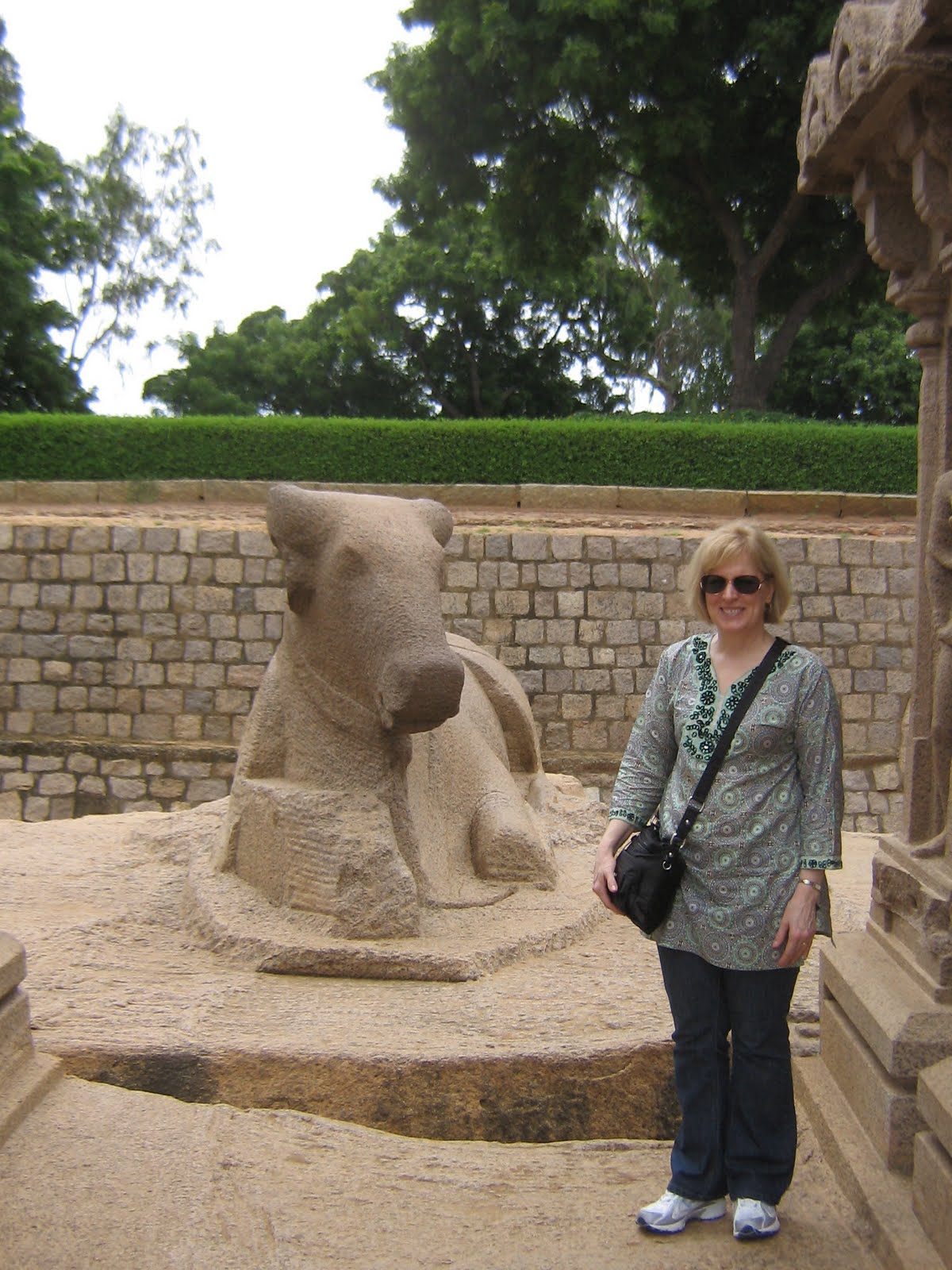
We started with the complex of temples all carved out of one rock. Each temple had at least one god as the occupant: Shiva being one, Parvati being another, all part of the story which we eventually come to know as the Ramayana. While the artistic quality of the temples have been diminished by weathering, the concepts that the temples represent are complex and integrated suggesting the artists had a plan and the overall work had been created long before the first hammer hit stone.
Over the centuries that these various temples were constructed, different styles and different parts of the mythologies became more pronounced. The gods also took different forms, and the stories gained in complexity. Many of the bits and pieces of Hindu mythology that we run into today are portrayed on the various edifices throughout the complex. Note the Chinese influence on this lion below. Definitely speaks to the trading that was going on here during that time.

Now this Shiva temple was stone-on-stone construction and the mortar that holds it together was a local concoction of lime from seashells, sugar, and other local materials. All these were covered with sand by an ancient tsunami and uncovered by the British about 125 years ago. Now the India Archaeological Survey maintains the sites.


We'll be going on to Pondicherry and see some new age artifacts that are part of the landscape south of Mamallapuram. See you soon!

Thursday, September 9, 2010

Nataraja – The Dancing Shiva

The first place we were taken by our guide was a museum that was specifically for the bronze statues of the Hindu gods. There are two camps (as there always seems to be) among Hindus as to which god comes first. Shiva appears to have the edge over Vishnu simply by seniority. Shiva and his consort Parvati are mentioned in earlier texts than Vishnu and his consort Lakshmi. It also looks like this might also have aspects of a northy-southy thingy. Northy favoring Vishnu and southy favoring Shiva, but that is only from an estimate of volume of temples. We’ll talk about the temples in Mamallapuram where everybody is represented in temples that were constructed over a two hundred year period from the 6th to 8th centuries. Now Shiva and Parvati are an interesting set of deities. They both have bad tempers. And we found out from our guide that when you see the gods with four arms, that is to set them apart from us mere mortals. All of the sculptures and bronzes of Parvati suggest that India was one of the first places where surgeons and/or shaman performed breast implants. As Deb suggests, any woman whose breasts are that large and defy gravity ain't natural. When you see the gods with more than four arms, they’re pissed about something. Shiva got pissed at Parvati's first son who refused to allow him into Parvati’s house so Shiva, in a rage, cut off his head. Overcome with remorse (most abusers seem to have that same trait), he looks to find a replacement but only finds an elephant’s head which he puts on the body. Being a god, the boy doesn’t need anti-rejection meds, so the head stays and Hindus have Ganesh. Once again, Shiva decides that the elephant head was probably not his best choice, so he blesses Ganesh and says that Ganesh will always be the first god Hindis turn to for help. Parvati also has a hot temper and many images of her have many, many arms. Don’t cross Parvati. Been there. Strange as it may seem, the origins of Hindu culture had an equality of men and women, at lease with the gods. There are depictions of Shiva and Parvati merged into one – half male, half female, but not like what you see in Greenwich Village on Halloween. But Shiva dances. Of all his faults, Shiva brings some fundamental principles to Hinduism. He even has a different name when he dances. Many professional entertainers do this, so having a stage name of Nataraj is really very avant-garde since these Vedas were written in the 9th and 10th centuries AD. And, Nata is Sanskrit for dance and raj, of course, is king, so eat your heart out John Travolta. Shiva dances to the rhythm and harmony of life all the time balanced on a demon that represents illusion and ignorance. In a more modern expression “ Grace dances on your face”. Somehow we in the west have lost our ability to translate the tangible expressions of belief into abstractions of such beauty and eloquence. Yo, like what da f__k you talkin’ about? But India has gained, lost, and regained the temple dancing that represented Nataraj's dances that told stories, some didactic, but all very deliberate. Our guide took us to an elite school for the fine arts that keeps the dances alive. Chennai celebrates a dance festival every December. The school has been around just over 100 years. It was started and endowed by a woman of Indian descent who wanted to revive the dance traditions. The school is a blend of old school and new age. The surroundings are pastoral and the instructors are demanding of the students who come to learn the dance. Note that there is a westerner to the right of the picture. We noted quite a few. It has to be pretty difficult (1) learning the Tamil language, and (2) learning the dance. But telling your friends what you did for the summer: priceless and terribly hip. I took a short video of a practice, but as you will see, I turned the camera to to a vertical orientation, but my camera is not smart enough to turn the image. Of course, neither am I. But I've added some additional pictures below from the school because it was an experience.


Tuesday, September 7, 2010

Everyone knew her as Nancy – Part 2

Chennai, still Madras to those who live there, and the state of Tamil Nadu have a relatively long history. Madras has its colonial history dating back to the 1640’s when the East India Trading Company established its administrative offices there at Fort St. George. For nearly 200 years, the British administered their operations from Madras. In Tamil Nadu, cotton was and is king. In Tamil Nadu, Tamil is the regional language (duh), but Hindi, being a “northern” language is reluctantly spoken along with more-recognizable English than in Hyderabad. We collected our luggage after Deb had the initial less-than-Kingfisher experience with a Chennai airport washroom. Cue Martha Reeves’ “Nowhere to run, nowhere to hide”. By the time she staggered out, the luggage was on the carousel and we organized and ran for the exit.
Our local Chennai contact, Kamesh, met us along with our driver Rajkumar, and much to our delight, the “car” turned out to be a Toyota AUV (Asian utility vehicle), a legitimately eight-passenger vehicle. It was large, comfortable, and had a great A/C! Deb was delighted.
She had visions of our Hyderabad City Cab city cab experience. Our trip into the city center was during rush hour and it as a challenge. Like Hyderabad, an eight-lane boulevard is really 15 lanes. Points for Chennai – their roads are in better condition than Hyderabad, point against – the roads are more congested. Points for Chennai – their rickshaws are in much better shape than those in Hyderabad (a function of the road conditions). Our hotel, the Residency is in city center.
The growth of the city has all but blotted out the Raj. The old Fort is an active city and state government complex with the scattered remnants of colonial India being slowly consumed by the march of time. Just as St. Mary's church is obscured by the trees, Madras' colonial past is represented by a few artifacts scattered among the new vibrance of modern India. Another reason that the expunging of colonial history might, just might, be deliberate is that the British installed a Muslim Nawab during the Raj to rule over Tamil Nadu, a majority Hindi state. Seems the Sepoy elements of army came from Tamil Nadu and what the British call “mutiny”, Indians call the first steps toward independence. OK, enough history.
The marketplace for Chennai is like that in Hyderabad, the old markets still remain but high-end shopping can be found in city center. Our hotel is in the heart of the “posh” area not too far from the port of Chennai and the beaches on the Bay of Bengal. Deb and I are keenly aware that the temperature and humidity in Chennai is much higher than Hyderabad. I sweat, therefore, I am!


We’ll start the tours in the next posting. Get spiritual, it’ll help.

Monday, September 6, 2010

And everyone knew her as Nancy -- Part 1

Our trip to the southern east coast of India last weekend yielded an array of varying experiences and observations. I intend to provide a series of briefs that cover the varied subjects that arose out of our trip. But first and foremost, Hyderabad’s Rajiv Gandhi airport in Shamshabad has it all over Chennai’s airport. Oh, the jungle airstrip is just for affect. One of my colleagues at TNS conducted a study for the Port Authority of New York on customer perceptions and satisfaction with the four Port Authority airports in the New York/New Jersey area: JFK, Newark, LaGuardia, and Steward, the last being the latest addition and eventually destine to take part of the strain off the other three. The study looked at the customer experience at the airport: shopping, lounge areas, and, of course, restrooms to name a few. Both male and female travelers understand the importance of restrooms at airports. Even the Port Authority of New York believes in good restroom experience, Senator Larry Craig’s type of experience not being one of the criteria, particularly the “wide stance” argument.
It’s been just about two months since we first stumbled out of the Hyderabad airport at 12:30 in the morning. Last Thursday morning we trundled back into the airport, this time to fly domestically on none other than Kingfisher airlines. No, not the King Fish from the old Amos and Andy radio and TV series, but the same people who brew Kingfisher beer in India also maintain one of the largest domestic air carriers. I guess I don’t want to see what’s in the fridge in the crew lounge after working with Anheuser Busch years ago. We were treated to the “Kingfisher experience” which included (1) a greeter who instantly identified us as western tourists (duh), (2) took us to the Kingfisher check-in kiosk where another Kingfisher representative took our confirmation numbers and (after an Indian 2-minute check-in) we were guided by the Kingfisher greeter to the Kingfisher check-in desk. Deb and I are still trying to understand what the Kingfisher kiosk experience was supposed to accomplish. Never mind. Moving on: (3) the Kingfisher rep checked in our bags and gave us our boarding passes, (4) we headed to the segregated security (men versus women – and there’s more about that in a later post as well). This really wasn’t a unique Kingfisher experience, but, OK, I screwed up. I took the sun block lotion and bug spray in my backpack. I took the first aid kit as well which contained blunt-nosed scissors – a no-no. Indian security has become sensitive since that Mumbai incident when 50 Pakistanis came into Mumbai carrying some serious armaments that weren’t detected. It reminds me of the Dallas Police who didn’t see Jack Ruby with the drawn gun in November 1963. Well, anyway, I had to take my pack back out and go through check-in for a second time. We went down to the gate to board the bus to take us to de plane. But Deb had taken her purse out of her carry-on and it didn’t have a tag on it. The Kingfisher experience was deteriorating as the security guy mumbled something like “you’re going to have to go back to check-in” at which point Deb was ready to detonate. However, her quick thinking said “I’m gonna stuff my purse back in my carry-on which has the tag which seemed to be just fine with security. Now Deb’s purse could have had enough C4 to level one of the tent cities and certainly enough to bring down the plane, but OK, OK, checked carry on was OK.
We just starting (5) arrive at the plane, rear door has stairs. Final Kingfisher rep checks boarding pass at bottom of stairs. Enter cabin. Walk forward. Sit down. Kingfisher experience has two rows facing in the front. Fortunately we’re facing forward. Deb would NOT have been able to take a rear-facing flight. Instructions from the Kingfisher in-flight attendant is canned, our REAL Kingfisher attendant is not into the instructions today. (6) We actually leave the boarding area on time!!! As we are taxiing to the runway, the Kingfisher experience continues with the attendant dropping off a micro-processed bottle of Kingfisher water and a yellow loaf in plastic wrap. All the Indian passengers (read everyone except us) unwraps the loaf. We follow. The loaf is a moist corn-meal like texture with a filling that has recognizable kernels of corn and something else – elusive in both taste and texture. We eat it. It’s part of the Kingfisher experience. We spend the rest of the trip filling out a Kingfisher air club application and the customer satisfaction survey. The survey scale is from “wow” to “poor”. I really didn’t get a “wow” from any of the experiences so far, but I hope the crew is not threatened by their supervisors for not getting “wow”s for everything. Besides, as a researcher, I was probably the only person that filled it out.
(7) We land – on time. Not bad!
The next installment gets us into our tour of Chennai. See you later.