Well, it’s time to get in on the festivities.
Wednesday, September 15, 2010
Party Down
With articles in the Deccan Chronicle about peace and harmony between Muslims and Hindi, the convergence of two big holidays: EID and Ganesha Puja went on last Saturday and both groups were in full partaaaaay mode. Now one of the things we learned about Ramzan (Ramadan for all the rest of the world) is that it is a joyous time as well as spiritual. The entire time during Ramzan was spent by the Muslim community, well, spending. If you can’t eat between sun up and sunset, you might as well spend money. And spend they did. People recommend not going down to the Charminar during Ramzan, for personal safety reasons but none for criminal reasons, except for what the vendors are charging. Wall-to-wall burqas, bangles and beads. Wright and Forrest, anyone? This whole fasting thing is punctuated by the sirens sounding at sunset so that everyone starts eating. This culminates at ID when you party till you puke. And that really takes a lot since there’s no alcohol. Now I know of two guys who actually went on the 11 day retreat where you fast and pray, pray and fast. But that seems like the minority.
Anyhow, Ganesh gets his due for the next 11 days after ID. The many temporary shrines pop up virtually overnight. The Ganeshes that populate these shrines are at various levels of detail, but the one at Hypercity, a local all-in-one store, was of particular interest being made entirely of biscuits and cookies. It is difficult to get through our neighborhood without stepping on someone’s Rangoli.
When we take a walk in the morning through our neighborhood (Deb and I, and the domestics, street sweepers, drivers, dogs, chickens, and school kids waiting for their bus) you will see someone from the household drawing on the driveways.
Some are simple white chalk outlines, others are multi-colored and quite large.
Well, it’s time to get in on the festivities.
And we celebrated by going to the Golconda fort and climbing to the top with a one-time Hyderabad homey who now teaches at Bowling Green State University who had never been to the fort. Stay tuned.
Well, it’s time to get in on the festivities.
Friday, September 10, 2010
Mamallapuram
Mamallapuram, which I believe means “it’s good to be the ruler” in the archaic Tamil dialect, is located on the Bay of Bengal about 100 kilometers south of Chennai. The area was the seat of power for the eastern lower half of India during the 6th to 9th centuries AD. It appears that the rise of political power came from uniting fairly unorganized tribes who migrated south when the Aryans moved into the northern part of India about 1500 BC. The fact that it took over 2000 years to get organized points directly to the concept of IST or India Stretch Time which we have experienced for the last two months. But considering the time difference, most of our challenges have been overcome in the blink of an eye.
There was a large government project also under construction on the way to Mamallapuram that was desalinization plants to help supply Chennai and the area with more water. Something we should think about in the US as well.
Anyhow, we met our guide Irudhayam, Irud for short, as he stretched himself across the street in front of our vehicle. Rajkumar couldn’t get around him and before you knew it, he was seated in the front passenger seat after a brief negotiation of a fee for the two hours we would be there. As you can imagine, Irud was connected with all the vendors in the shops that lined the path to the government ticket office.
There were the pathetic-looking beggars along the walk as well. However, when you see them try to hide their stainless steel lunch pails, part of the pathos evaporates. There appears to be a symbiosis of all the folks who are supported by the tourist trade here. The nods to one another or a sharp word between our guide and a vendor suggested the system was well mapped out and boundaries were established that one should not cross.
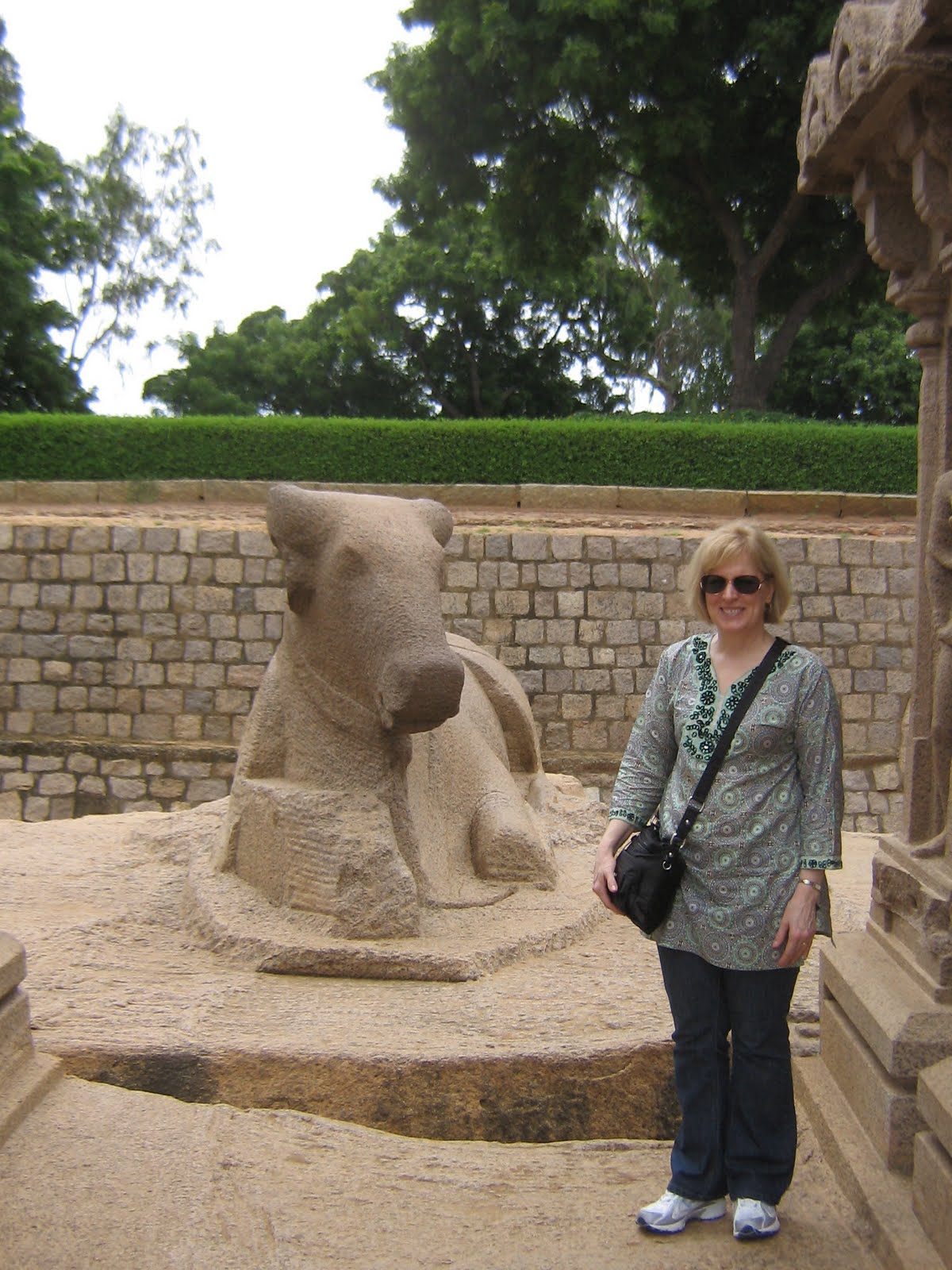
Over the centuries that these various temples were constructed, different styles and different parts of the mythologies became more pronounced. The gods also took different forms, and the stories gained in complexity. Many of the bits and pieces of Hindu mythology that we run into today are portrayed on the various edifices throughout the complex. Note the Chinese influence on this lion below. Definitely speaks to the trading that was going on here during that time.
Thursday, September 9, 2010
Nataraja – The Dancing Shiva
Now Shiva and Parvati are an interesting set of deities. They both have bad tempers. And we found out from our guide that when you see the gods with four arms, that is to set them apart from us mere mortals. All of the sculptures and bronzes of Parvati suggest that India was one of the first places where surgeons and/or shaman performed breast implants. As Deb suggests, any woman whose breasts are that large and defy gravity ain't natural. When you see the gods with more than four arms, they’re pissed about something. Shiva got pissed at Parvati's first son who refused to allow him into Parvati’s house so Shiva, in a rage, cut off his head. Overcome with remorse (most abusers seem to have that same trait), he looks to find a replacement but only finds an elephant’s head which he puts on the body. Being a god, the boy doesn’t need anti-rejection meds, so the head stays and Hindus have Ganesh. Once again, Shiva decides that the elephant head was probably not his best choice, so he blesses Ganesh and says that Ganesh will always be the first god Hindis turn to for help. Parvati also has a hot temper and many images of her have many, many arms. Don’t cross Parvati. Been there. Strange as it may seem, the origins of Hindu culture had an equality of men and women, at lease with the gods.
There are depictions of Shiva and Parvati merged into one – half male, half female, but not like what you see in Greenwich Village on Halloween.
But Shiva dances. Of all his faults, Shiva brings some fundamental principles to Hinduism. He even has a different name when he dances. Many professional entertainers do this, so having a stage name of Nataraj is really very avant-garde since these Vedas were written in the 9th and 10th centuries AD. And, Nata is Sanskrit for dance and raj, of course, is king, so eat your heart out John Travolta.
Shiva dances to the rhythm and harmony of life all the time balanced on a demon that represents illusion and ignorance. In a more modern expression “ Grace dances on your face”. Somehow we in the west have lost our ability to translate the tangible expressions of belief into abstractions of such beauty and eloquence. Yo, like what da f__k you talkin’ about? But India has gained, lost, and regained the temple dancing that represented Nataraj's dances that told stories, some didactic, but all very deliberate. Our guide took us to an elite school for the fine arts that keeps the dances alive.Tuesday, September 7, 2010
Everyone knew her as Nancy – Part 2
Chennai, still Madras to those who live there, and the state of Tamil Nadu have a relatively long history. Madras has its colonial history dating back to the 1640’s when the East India Trading Company established its administrative offices there at Fort St. George. For nearly 200 years, the British administered their operations from Madras. In Tamil Nadu, cotton was and is king. In Tamil Nadu, Tamil is the regional language (duh), but Hindi, being a “northern” language is reluctantly spoken along with more-recognizable English than in Hyderabad. We collected our luggage after Deb had the initial less-than-Kingfisher experience with a Chennai airport washroom.
Cue Martha Reeves’ “Nowhere to run, nowhere to hide”. By the time she staggered out, the luggage was on the carousel and we organized and ran for the exit.
Our local Chennai contact, Kamesh, met us along with our driver Rajkumar, and much to our delight, the “car” turned out to be a Toyota AUV (Asian utility vehicle), a legitimately eight-passenger vehicle. It was large, comfortable, and had a great A/C! Deb was delighted.
She had visions of our Hyderabad City Cab city cab experience. Our trip into the city center was during rush hour and it as a challenge. Like Hyderabad, an eight-lane boulevard is really 15 lanes.
Points for Chennai – their roads are in better condition than Hyderabad, point against – the roads are more congested. Points for Chennai – their rickshaws are in much better shape than those in Hyderabad (a function of the road conditions). Our hotel, the Residency is in city center.
The growth of the city has all but blotted out the Raj. The old Fort is an active city and state government complex with the scattered remnants of colonial India being slowly consumed by the march of time. Just as St. Mary's church is obscured by the trees, Madras' colonial past is represented by a few artifacts scattered among the new vibrance of modern India.
Another reason that the expunging of colonial history might, just might, be deliberate is that the British installed a Muslim Nawab during the Raj to rule over Tamil Nadu, a majority Hindi state. Seems the Sepoy elements of army came from Tamil Nadu and what the British call “mutiny”, Indians call the first steps toward independence. OK, enough history.
The marketplace for Chennai is like that in Hyderabad, the old markets still remain but high-end shopping can be found in city center. Our hotel is in the heart of the “posh” area not too far from the port of Chennai and the beaches on the Bay of Bengal. Deb and I are keenly aware that the temperature and humidity in Chennai is much higher than Hyderabad. I sweat, therefore, I am!

Cue Martha Reeves’ “Nowhere to run, nowhere to hide”. By the time she staggered out, the luggage was on the carousel and we organized and ran for the exit.Our local Chennai contact, Kamesh, met us along with our driver Rajkumar, and much to our delight, the “car” turned out to be a Toyota AUV (Asian utility vehicle), a legitimately eight-passenger vehicle. It was large, comfortable, and had a great A/C! Deb was delighted.
She had visions of our Hyderabad City Cab city cab experience. Our trip into the city center was during rush hour and it as a challenge. Like Hyderabad, an eight-lane boulevard is really 15 lanes.
The growth of the city has all but blotted out the Raj. The old Fort is an active city and state government complex with the scattered remnants of colonial India being slowly consumed by the march of time. Just as St. Mary's church is obscured by the trees, Madras' colonial past is represented by a few artifacts scattered among the new vibrance of modern India.
The marketplace for Chennai is like that in Hyderabad, the old markets still remain but high-end shopping can be found in city center. Our hotel is in the heart of the “posh” area not too far from the port of Chennai and the beaches on the Bay of Bengal. Deb and I are keenly aware that the temperature and humidity in Chennai is much higher than Hyderabad. I sweat, therefore, I am!
Monday, September 6, 2010
And everyone knew her as Nancy -- Part 1
Our trip to the southern east coast of India last weekend yielded an array of varying experiences and observations. I intend to provide a series of briefs that cover the varied subjects that arose out of our trip.
But first and foremost, Hyderabad’s Rajiv Gandhi airport in Shamshabad has it all over Chennai’s airport.
Oh, the jungle airstrip is just for affect. One of my colleagues at TNS conducted a study for the Port Authority of New York on customer perceptions and satisfaction with the four Port Authority airports in the New York/New Jersey area: JFK, Newark, LaGuardia, and Steward, the last being the latest addition and eventually destine to take part of the strain off the other three. The study looked at the customer experience at the airport: shopping, lounge areas, and, of course, restrooms to name a few. Both male and female travelers understand the importance of restrooms at airports. Even the Port Authority of New York believes in good restroom experience, Senator Larry Craig’s type of experience not being one of the criteria, particularly the “wide stance” argument.
It’s been just about two months since we first stumbled out of the Hyderabad airport at 12:30 in the morning.
Last Thursday morning we trundled back into the airport, this time to fly domestically on none other than Kingfisher airlines. No, not the King Fish from the old Amos and Andy radio and TV series, but the same people who brew Kingfisher beer in India also maintain one of the largest domestic air carriers.
I guess I don’t want to see what’s in the fridge in the crew lounge after working with Anheuser Busch years ago. We were treated to the “Kingfisher experience” which included (1) a greeter who instantly identified us as western tourists (duh), (2) took us to the Kingfisher check-in kiosk where another Kingfisher representative took our confirmation numbers and (after an Indian 2-minute check-in) we were guided by the Kingfisher greeter to the Kingfisher check-in desk. Deb and I are still trying to understand what the Kingfisher kiosk experience was supposed to accomplish. Never mind. Moving on: (3) the Kingfisher rep checked in our bags and gave us our boarding passes, (4) we headed to the segregated security (men versus women – and there’s more about that in a later post as well). This really wasn’t a unique Kingfisher experience, but, OK, I screwed up. I took the sun block lotion and bug spray in my backpack. I took the first aid kit as well which contained blunt-nosed scissors – a no-no. Indian security has become sensitive since that Mumbai incident when 50 Pakistanis came into Mumbai carrying some serious armaments that weren’t detected. It reminds me of the Dallas Police who didn’t see Jack Ruby with the drawn gun in November 1963.
Well, anyway, I had to take my pack back out and go through check-in for a second time. We went down to the gate to board the bus to take us to de plane. But Deb had taken her purse out of her carry-on and it didn’t have a tag on it. The Kingfisher experience was deteriorating as the security guy mumbled something like “you’re going to have to go back to check-in” at which point Deb was ready to detonate. However, her quick thinking said “I’m gonna stuff my purse back in my carry-on which has the tag which seemed to be just fine with security. Now Deb’s purse could have had enough C4 to level one of the tent cities and certainly enough to bring down the plane, but OK, OK, checked carry on was OK.
We just starting (5) arrive at the plane, rear door has stairs. Final Kingfisher rep checks boarding pass at bottom of stairs. Enter cabin. Walk forward. Sit down. Kingfisher experience has two rows facing in the front. Fortunately we’re facing forward. Deb would NOT have been able to take a rear-facing flight. Instructions from the Kingfisher in-flight attendant is canned, our REAL Kingfisher attendant is not into the instructions today. (6) We actually leave the boarding area on time!!! As we are taxiing to the runway, the Kingfisher experience continues with the attendant dropping off a micro-processed bottle of Kingfisher water and a yellow loaf in plastic wrap. All the Indian passengers (read everyone except us) unwraps the loaf. We follow. The loaf is a moist corn-meal like texture with a filling that has recognizable kernels of corn and something else – elusive in both taste and texture. We eat it. It’s part of the Kingfisher experience. We spend the rest of the trip filling out a Kingfisher air club application and the customer satisfaction survey. The survey scale is from “wow” to “poor”. I really didn’t get a “wow” from any of the experiences so far, but I hope the crew is not threatened by their supervisors for not getting “wow”s for everything. Besides, as a researcher, I was probably the only person that filled it out.
(7) We land – on time. Not bad!
The next installment gets us into our tour of Chennai. See you later.
But first and foremost, Hyderabad’s Rajiv Gandhi airport in Shamshabad has it all over Chennai’s airport.
Oh, the jungle airstrip is just for affect. One of my colleagues at TNS conducted a study for the Port Authority of New York on customer perceptions and satisfaction with the four Port Authority airports in the New York/New Jersey area: JFK, Newark, LaGuardia, and Steward, the last being the latest addition and eventually destine to take part of the strain off the other three. The study looked at the customer experience at the airport: shopping, lounge areas, and, of course, restrooms to name a few. Both male and female travelers understand the importance of restrooms at airports. Even the Port Authority of New York believes in good restroom experience, Senator Larry Craig’s type of experience not being one of the criteria, particularly the “wide stance” argument.It’s been just about two months since we first stumbled out of the Hyderabad airport at 12:30 in the morning.
Last Thursday morning we trundled back into the airport, this time to fly domestically on none other than Kingfisher airlines. No, not the King Fish from the old Amos and Andy radio and TV series, but the same people who brew Kingfisher beer in India also maintain one of the largest domestic air carriers.
I guess I don’t want to see what’s in the fridge in the crew lounge after working with Anheuser Busch years ago. We were treated to the “Kingfisher experience” which included (1) a greeter who instantly identified us as western tourists (duh), (2) took us to the Kingfisher check-in kiosk where another Kingfisher representative took our confirmation numbers and (after an Indian 2-minute check-in) we were guided by the Kingfisher greeter to the Kingfisher check-in desk. Deb and I are still trying to understand what the Kingfisher kiosk experience was supposed to accomplish. Never mind. Moving on: (3) the Kingfisher rep checked in our bags and gave us our boarding passes, (4) we headed to the segregated security (men versus women – and there’s more about that in a later post as well). This really wasn’t a unique Kingfisher experience, but, OK, I screwed up. I took the sun block lotion and bug spray in my backpack. I took the first aid kit as well which contained blunt-nosed scissors – a no-no. Indian security has become sensitive since that Mumbai incident when 50 Pakistanis came into Mumbai carrying some serious armaments that weren’t detected. It reminds me of the Dallas Police who didn’t see Jack Ruby with the drawn gun in November 1963.
Well, anyway, I had to take my pack back out and go through check-in for a second time. We went down to the gate to board the bus to take us to de plane. But Deb had taken her purse out of her carry-on and it didn’t have a tag on it. The Kingfisher experience was deteriorating as the security guy mumbled something like “you’re going to have to go back to check-in” at which point Deb was ready to detonate. However, her quick thinking said “I’m gonna stuff my purse back in my carry-on which has the tag which seemed to be just fine with security. Now Deb’s purse could have had enough C4 to level one of the tent cities and certainly enough to bring down the plane, but OK, OK, checked carry on was OK.We just starting (5) arrive at the plane, rear door has stairs. Final Kingfisher rep checks boarding pass at bottom of stairs. Enter cabin. Walk forward. Sit down. Kingfisher experience has two rows facing in the front. Fortunately we’re facing forward. Deb would NOT have been able to take a rear-facing flight. Instructions from the Kingfisher in-flight attendant is canned, our REAL Kingfisher attendant is not into the instructions today. (6) We actually leave the boarding area on time!!! As we are taxiing to the runway, the Kingfisher experience continues with the attendant dropping off a micro-processed bottle of Kingfisher water and a yellow loaf in plastic wrap. All the Indian passengers (read everyone except us) unwraps the loaf. We follow. The loaf is a moist corn-meal like texture with a filling that has recognizable kernels of corn and something else – elusive in both taste and texture. We eat it. It’s part of the Kingfisher experience. We spend the rest of the trip filling out a Kingfisher air club application and the customer satisfaction survey. The survey scale is from “wow” to “poor”. I really didn’t get a “wow” from any of the experiences so far, but I hope the crew is not threatened by their supervisors for not getting “wow”s for everything. Besides, as a researcher, I was probably the only person that filled it out.
(7) We land – on time. Not bad!
The next installment gets us into our tour of Chennai. See you later.
Tuesday, August 31, 2010
Reddy, Reddi, Reddy
It's been a few days, but we're in the throes of getting the apartment where it is almost home-like. As Deb and I have started to explore the MLA Colony on foot, there are a few things that stand out. First, there are far more Reddy's and Reddi's than Patels or any other names for that matter in our neighborhood. We know this because virtually every home has a placard posted on the gate with the family name and, in some cases, what the primary head of household does or did. Most of the doctors have this on their gate. The former police commissioner of Hyderabad proudly posts this on his gate. We generally walk early in the morning, so the maids, servants, gardeners, and drivers are out and about preparing for another day. The driveways and cars get a daily wash. Many of the homes have a servant draw a Rangoli on the driveway in chalk.
One of the most noticeable features virtually anywhere you go in Hyderabad are the feral dogs. A few homes have domesticated pets, but the dogs are ubiquitous in every neighborhood. And when you use the term "mangy lot" in describing a group of animals or people, the dogs of Hyderabad should be your paradigm. If you've seen the animated movie "Ratatouille", the brother of the rat-hero Remy, Emile gives you an image of how discerning these dogs are when it comes to just about any aspect of life on the streets. Disney's "Lady and the Tramp" would need to be titled VERY differently, cause these female dogs ain't no ladies.
However, to give you another visual, maybe Dog and his wife are a good example of the look of many of these street creatures. One of the many nursing females uses the dumpster down the hill from us for her buffet meals and while I don't have a shot of it, this is not a pretty sight.We'll be in Chennai on Thursday, so I'll have some things of interest to write about shortly. Have a great day.
Tuesday, August 24, 2010
A Disappearing Number

Whoa, that was close. The vortex of life power generated from the inner peace that surrounds the auditorium began to pull me back to 1967 but I managed to escape its surge. It’s much like the time Deb, the kids, and I were in Sedona, AZ. We stayed at this motor lodge on the mesa just about town. There was a beautiful red rock formation on the vista from the office. As I was probably foraging for breakfast stuff in their lobby area, I overheard the conversation between two people I assumed were fellow lodgers and the front desk clerk. The guests were asking where the life power center was nearby the motel. The desk clerk explained how the guests simply needed to go out the door and the path was just off the parking lot. The guests were to walk a short distance and they would begin to sense the center’s presence. That was one of those moments I just wanted to have a spiritual bookstore on the main drag in town.
Boss, de play, de play!
A Disappearing Number got to India and specifically to Hyderabad after three years of negotiations and efforts from the University of Hyderabad Mathematics Department.
How appropriate that this play, with part of its storyline highlighting the collaboration of British Mathematician G H Hardy and Srinivasa Ramanujan, the brilliant Indian math theoretician, could be here during the International Congress of Mathematicians. The auditorium had all the comforts with theatre seating, but no cup holders.As the play starts, one of the first people we meet becomes a partner to the current-time storyline. She is a mathematician and shows a fascination with the concepts of Ramanujan and philosophic perspectives on mathematics of Hardy. This continues throughout the play. The second character we meet eventually reveals himself to be a physicist of Indian origin. This character addresses the audience with the premise of the play: that only the math is real and constant. The original actor who came on stage beforehand is finally introduced as what will become the other part of the current-time story, a non-resident Indian who has infinity phobia, but has the hots for the math chick. There was a dry British wit that was woven throughout the play. Guess what – totally lost on the Indians. Actually I didn’t hear many guffaws from any of the math geeks either. One of the math guys we noted before the play started looked as though the 60’s were good to him.

Anyhow, the play did include multimedia effects, two story lines and nearly half the cast is run over by a lorry or oxcart by the end of the play. I’m not going to be a spoiler. You’ll have to see or read it to actually know what goes on. Let’s face it, the only play that really has a storyline you describe in the same length of time it takes to perform it is Samuel Beckett’s “Breathe”: twenty-six seconds.
As we were exiting from the play, I phoned the cab driver who started yelling on the phone, “I coming, I find you.” We moved slowly out of the hall and out onto the marble entryway. The smallish courtyard in front of the auditorium was pandemonium with buses, cabs, and people all moving around. The police were there making a feeble attempt to move the buses and cabs. I saw a cab, but the driver wasn’t wearing his cap. Deb was looking and saying, that’s not our cab, but the driver was waving frantically and yelling “I find you, I find you”. We jumped in and off we went for the second part of our adventurous city cab ride. Traffic was much lighter going back and many of the rivers of water from the earlier deluge had become trickles. So our driver had a much easier time, though he still was heavy-thumbed on the horn. However, we could tell he was relaxed when he put in a CD of Bollywood favorites (well, we think they were Bollywood favorites) and he began singing along. Sometimes even in a falsetto. It was almost charming – almost.
He made his way back with Deb’s directions of “rights”, and “lefts” and “straights”. He pulled into our parking garage, got out to open our door, and was saying “anytime, you call, I come for you”. I paid the contract fee and gave him a tip just for finding us and getting us home with entertainment.
I’m exhausted just remembering these events. Next posting is about our new produce shopping experiences in the local markets. They’re more experiences on the list. Stay tuned.
Subscribe to:
Posts (Atom)